

What Are Chart of Accounts? How It Works, Setting up & Pros

Each account in this example can be further detailed or expanded based on the specific needs of the business, such as adding separate accounts for different types of services or inventory. A chart of accounts is a document that numbers and lists all the financial transactions that a company conducts in an accounting period. The information is usually arranged in categories that match those on the balance sheet and income statement. You can usually find your assets on the balance sheet (one of the three standard business financial statements) that provides a snapshot of a company’s financial position at a specific moment.
Determine the structure of your COA
Our goal is to deliver the most understandable and comprehensive explanations of financial topics using simple writing complemented by helpful graphics and animation videos. We follow strict ethical journalism practices, order of liquidity which includes presenting unbiased information and citing reliable, attributed resources. This team of experts helps Finance Strategists maintain the highest level of accuracy and professionalism possible.
- To better understand the balance sheet and income statement, you need to first understand the components that make up a chart of accounts.
- But experience has shown that the most common format organizes information by individual account and assigns each account a code and description.
- When you log in to your account online, you’ll typically go to an overview page that shows the balance in each account.
- Daniel Liberto is a journalist with over 10 years of experience working with publications such as the Financial Times, The Independent, and Investors Chronicle.
- These are asset accounts, liability accounts, equity accounts, revenue accounts, and expense accounts.
Account categories
The COA is tailored to an organization’s needs and can vary widely in complexity. Integrating the COA with accounting software or systems streamlines financial operations by automating data entry, ensuring accuracy, and facilitating real-time reporting. It enables a direct link between financial transactions and the COA, reducing manual errors and enhancing efficiency.
Accounting
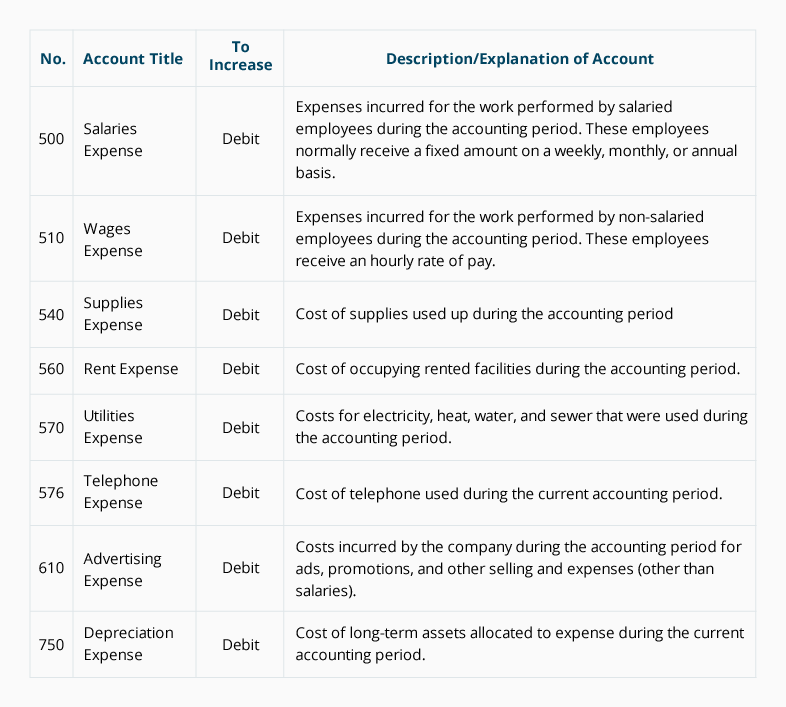
The basic set of accounts is similar for all businesses, regardless of the type, size, or industry. This way, whether you’re setting up restaurant bookkeeping or ecommerce accounting, you follow the standard chart of accounts. Start with a simple COA structure that covers all the fundamental areas of your business finances but is also flexible enough to scale as your business grows. Avoid creating too many specific accounts initially; instead, add them as your business needs evolve. Setting up a chart of accounts (COA) is a critical step for any business to effectively manage its financial records. Here’s a step-by-step guide to help you establish a COA that suits your business needs and enhances your financial reporting capabilities.
Chart of Accounts: A Comprehensive Guide with Real-World Examples
Get free guides, articles, tools and calculators to help you navigate the financial side of your business with ease. The magic happens when our intuitive software and real, human support come together. Book a demo today to see what running your business is like with Bench. At the end of the year, review all of your accounts and see if there’s an opportunity for consolidation. Here’s how to categorize transactions in QuickBooks Online and navigate the COA.
Unique identification
Consider creating separate line items in your chart of accounts for different types of income. Instead of lumping all your income into one account, assess your various profitable activities and sort them by income type. Each category will include specific accounts for your business, like a business vehicle that you own would be recorded as an asset account. Every time you add or remove an account from your business, it’s important to record it in your books and your chart of accounts (COA) helps you do that. There are many different ways to structure a chart of accounts, but the important thing to remember is that simplicity is key. The more accounts are added to the chart and the more complex the numbering system is, the more difficult it will be to keep track of them and actually use the accounting system.
Business needs and regulations change over time, so it’s important to review your COA periodically to ensure it continues to meet your business requirements. This might involve adding new accounts, removing redundant ones, or restructuring sections to improve clarity and functionality. This numbering system can vary greatly depending on the size of the business and its specific needs, but it generally follows this logical progression to keep financial activities well-organized. For information pertaining to the registration status of 11 Financial, please contact the state securities regulators for those states in which 11 Financial maintains a registration filing. A chart of accounts is a list of all accounts used by a company in its accounting system.
Integration allows for a smooth flow of information between different modules or components of an accounting system. When a transaction occurs, it automatically reflects in the corresponding COA account, eliminating the need for manual input and reducing the risk of discrepancies. Equity can fall into several accounts, reflecting different aspects of ownership in the company. Let’s look at the anatomy of the chart of accounts – what it comprises, why you need it, and what goes where within this framework. The structure of a COA can be customized to fit the specific needs of a business. While smaller businesses may have a simpler, less detailed COA, larger enterprises might require a more complex and detailed structure to accommodate various departments, projects, or locations.
Minden vélemény számít!